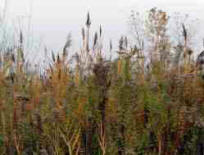
Tares
[This chapter is based on Matt. 13:24-30, 37-43.]
Another parable put He forth unto them, saying, The kingdom of heaven is likened unto a
man which sowed good seed in his field; but while men slept, his enemy came and sowed
tares among the wheat, and went his way. But when the blade was sprung up, and brought
forth fruit, then appeared the tares also."
"The field," Christ said, "is the world." But we must understand
this as signifying the church of Christ in the world. The parable is a description of that
which pertains to the kingdom of God, His work of salvation of men; and this work is
accomplished through the church. True, the Holy Spirit has gone out into all the world;
everywhere it is moving upon the hearts of men; but it is in the church that we are to
grow and ripen for the garner of God.
"He that sowed the good seed is the Son of man. . . . The good seed are the
children of the kingdom; but the tares are the children of the wicked one." The good
seed represents those who are born of the word of God, the truth. The tares represent a class who are the fruit or embodiment of error,
of false principles. "The enemy that sowed them is the devil." Neither God nor
His angels ever sowed a seed that would produce a tare. The tares are always sown by
Satan, the enemy of God and man.
In the East, men sometimes took revenge upon an enemy by strewing his newly sown fields
with the seeds of some noxious weed that, while growing, closely resembled wheat.
Springing up with the wheat, it injured the crop and brought trouble and loss to the owner
of the field. So it is from enmity to Christ that Satan scatters his evil seed among the
good grain of the kingdom. The fruit of his sowing he attributes to the Son of God. By
bringing into the church those who bear Christ's name while they deny His character, the
wicked one causes that God shall be dishonored, the work of salvation misrepresented, and
souls imperiled.
Christ's servants are grieved as they see true and false believers mingled in the
church. They long to do something to cleanse the church. Like the servants of the
householder, they are ready to uproot the tares. But Christ says to them, "Nay; lest
while ye gather up the tares, ye root up also the wheat with them. Let both grow together
until the harvest."
Christ has plainly taught that those who persist in open sin must be separated from the
church, but He has not committed to us the work of judging character and motive. He knows
our nature too well to entrust this work to us. Should we try to uproot from the church
those whom we suppose to be spurious Christians, we should be sure to make mistakes. Often
we regard as hopeless subjects the very ones whom Christ is drawing to Himself. Were we
to deal with these souls according to our imperfect judgment, it would perhaps
extinguish their last hope. Many who think themselves Christians will at last be found
wanting. Many will be in heaven who their neighbors supposed would never enter there. Man
judges from appearance, but God judges the heart. The tares and the wheat are to grow
together until the harvest; and the harvest is the end of probationary time.
There is in the Saviour's words another lesson, a lesson of wonderful forbearance and
tender love. As the tares have their roots closely intertwined with those of the good
grain, so false brethren in the church may be closely linked with true disciples. The real
character of these pretended believers is not fully manifested. Were they to be separated
from the church, others might be caused to stumble, who but for this would have remained
steadfast.
The teaching of this parable is illustrated in God's own dealing with men and angels.
Satan is a deceiver. When he sinned in heaven, even the loyal angels did not fully discern
his character. This was why God did not at once destroy Satan. Had He done so, the holy
angels would not have perceived the justice and love of God. A doubt of God's goodness
would have been as evil seed that would yield the bitter fruit of sin and woe. Therefore
the author of evil was spared, fully to develop his character. Through long ages God has
borne the anguish of beholding the work of evil, He has given the infinite Gift of
Calvary, rather than leave any to be deceived by the misrepresentations of the wicked one;
for the tares could not be plucked up without danger of uprooting the precious grain. And
shall we not be as forbearing toward our fellow men as the Lord of heaven and earth is
toward Satan?
The world has no right to doubt the truth of Christianity
because there are unworthy members in the church, nor should Christians become
disheartened because of these false brethren. How was it with the early church? Ananias
and Sapphira joined themselves to the disciples. Simon Magus was baptized. Demas, who
forsook Paul, had been counted a believer. Judas Iscariot was numbered with the apostles.
The Redeemer does not want to lose one soul; His experience with Judas is recorded to show
His long patience with perverse human nature; and He bids us bear with it as He has borne.
He has said that false brethren will be found in the church till the close of time.
Notwithstanding Christ's warning, men have sought to uproot the tares. To punish those
who were supposed to be evildoers, the church has had recourse to the civil power. Those
who differed from the established doctrines have been imprisoned, put to torture and to
death, at the instigation of men who claimed to be acting under the sanction of Christ.
But it is the spirit of Satan, not the Spirit of Christ, that inspires such acts. This is
Satan's own method of bringing the world under his dominion. God has been misrepresented
through the church by this way of dealing with those supposed to be heretics.
Not judgment and condemnation of others, but humility and distrust of self, is the
teaching of Christ's parable. Not all that is sown in the field is good grain. The fact
that men are in the church does not prove them Christians.
The tares closely resembled the wheat while the blades were green; but when the field
was white for the harvest, the worthless weeds bore no likeness to the wheat that bowed
under the weight of its full, ripe heads. Sinners who make a pretension of piety mingle
for a time with the true followers of Christ, and the semblance of Christianity is
calculated to deceive many; but in the harvest of the world there will be no likeness
between good and evil. Then those who have joined the church, but who have not joined
Christ, will be manifest.
The tares are permitted to grow among the wheat, to have all the advantage of sun and
shower; but in the time of harvest ye shall "return, and discern between the
righteous and the wicked, between him that serveth God and him that serveth Him not."
Mal. 3:18. Christ Himself will decide who are worthy to dwell with the family of heaven.
He will judge every man according to his words and his works. Profession is as nothing in
the scale. It is character that decides destiny.
The Saviour does not point forward to a time when all the tares become wheat. The wheat
and tares grow together until the harvest, the end of the world. Then the tares are bound
in bundles to be burned, and the wheat is gathered into the garner of God. "Then
shall the righteous shine forth as the sun in the kingdom of their Father." Then
"the Son of man shall send forth His angels, and they shall gather out of His kingdom
all things that offend, and them which do iniquity; and shall cast them into a furnace of
fire; there shall be wailing and gnashing of teeth."
|
