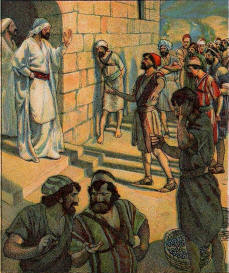
The Reward of Grace
[This chapter is based on Matt. 19:16-30, 20:1-16; Mark 10:17-31; Luke
18:18-30.]
The truth of God's free grace had been almost lost sight of by the Jews. The rabbis
taught that God's favor must be earned. The reward of the righteous they hoped to gain by
their own works. Thus their worship was prompted by a grasping, mercenary spirit. From
this spirit even the disciples of Christ were not wholly free, and the Saviour sought
every opportunity of showing them their error. Just before He gave the parable of the
laborers, an event occurred that opened the way for Him to present the right principles.
As He was walking by the way, a young ruler came running to Him, and kneeling,
reverently saluted Him. "Good Master," he said, "what good thing shall I
do, that I may have eternal life?"
The ruler had addressed Christ merely as an honored rabbi, not discerning in Him the
Son of God. The Saviour said, "Why callest thou Me good? There is none good but one,
that is, God." On what ground do you call Me good? God is the one good. If you recognize Me as such, you must receive Me as His Son
and representative.
"If thou wilt enter into life," He added, "keep the commandments."
The character of God is expressed in His law; and in order for you to be in harmony with
God, the principles of His law must be the spring of your every action.
Christ does not lessen the claims of the law. In unmistakable language He presents
obedience to it as the condition of eternal life--the same condition that was required of
Adam before his fall. The Lord expects no less of the soul now than He expected of man in
Paradise, perfect obedience, unblemished righteousness. The requirement under the covenant
of grace is just as broad as the requirement made in Eden--harmony with God's law, which
is holy, just, and good.
To the words, "Keep the commandments," the young man answered,
"Which?" He supposed that some ceremonial precept was meant, but Christ was
speaking of the law given from Sinai. He mentioned several commandments from the second
table of the Decalogue, then summed them all up in the precept, "Thou shalt love thy
neighbour as thyself."
The young man answered without hesitation, "All these things have I kept from my
youth up; what lack I yet?" His conception of the law was external and superficial.
Judged by a human standard, he had preserved an unblemished character. To a great degree
his outward life had been free from guilt; he verily thought that his obedience had been
without a flaw. Yet he had a secret fear that all was not right between his soul and God.
This prompted the question, "What lack I yet?"
"If thou wilt be perfect," Christ said, "go and sell that thou hast, and
give to the poor, and thou shalt have treasure in heaven, and come and follow Me. But when the young man heard that saying, he went
away sorrowful; for he had great possessions."
The lover of self is a transgressor of the law. This Jesus desired to reveal to the
young man, and He gave him a test that would make manifest the selfishness of his heart.
He showed him the plague spot in his character. The young man desired no further
enlightenment. He had cherished an idol in the soul; the world was his god. He professed
to have kept the commandments, but he was destitute of the principle which is the very
spirit and life of them all. He did not possess true love for God or man. This want was
the want of everything that would qualify him to enter the kingdom of heaven. In his love
of self and worldly gain he was out of harmony with the principles of heaven.
When this young ruler came to Jesus, his sincerity and
earnestness won the Saviour's heart. He "beholding him loved him." In this
young man He saw one who might do service as a preacher of righteousness. He would have
received this talented and noble youth as readily as He received the poor fishermen who
followed Him. Had the young man devoted his ability to the work of saving souls, he might
have become a diligent and successful laborer for Christ.
But first he must accept the conditions of discipleship. He must give himself
unreservedly to God. At the Saviour's call, John, Peter, Matthew, and their companions
"left all, rose up, and followed Him." Luke 5:28. The same consecration was
required of the young ruler. And in this Christ did not ask a greater sacrifice than He
Himself had made. "He was rich, yet for your sakes He became poor, that ye through
His poverty might be rich." 2 Cor. 8:9. The young man had only to follow where Christ
led the way.
Christ looked upon the young man and longed after his soul. He longed to send him forth
as a messenger of blessing to men. In the place of that which He called upon him to
surrender, Christ offered him the privilege of companionship with Himself. "Follow
Me," He said. This privilege had been counted a joy by Peter, James, and John. The
young man himself looked upon Christ with admiration. His heart was drawn toward the
Saviour. But he was not ready to accept the Saviour's principle of self-sacrifice. He
chose his riches before Jesus. He wanted eternal life, but would not receive into the soul
that unselfish love which alone is life, and with a sorrowful heart he turned away from
Christ.
As the young man turned away, Jesus said to His disciples, "How hardly shall they
that have riches enter into the kingdom of God." These words astonished the
disciples. They had been taught to look upon the rich as the favorites of heaven;
worldly power and riches they themselves hoped to receive in the Messiah's kingdom; if the
rich were to fail of entering the kingdom, what hope could there be for the rest of men?
"Jesus answereth again, and saith unto them, Children, how hard is it for them
that trust in riches to enter into the kingdom of God! It is easier for a camel to go
through the eye of a needle, than for a rich man to enter into the kingdom of God. And
they were astonished out of measure." Now they realized that they themselves were
included in the solemn warning. In the light of the Saviour's words, their own secret
longing for power and riches was revealed. With misgivings for themselves they exclaimed,
"Who then can be saved?"
"Jesus looking upon them saith, With men it is impossible, but not with God; for
with God all things are possible."
A rich man, as such, cannot enter heaven. His wealth gives him no title to the
inheritance of the saints in light. It is only through the unmerited grace of Christ that
any man can find entrance into the city of God.
To the rich no less than to the poor are the words of the Holy Spirit spoken, "Ye
are not your own; for ye are bought with a price." 1 Cor. 6:19, 20. When men believe
this, their possessions will be held as a trust, to be used as God shall direct, for the
saving of the lost, and the comfort of the suffering and the poor. With man this is
impossible, for the heart clings to its earthly treasure. The soul that is bound in
service to mammon is deaf to the cry of human need. But with God all things are possible.
By beholding the matchless love of Christ, the selfish heart will be melted and subdued.
The rich man will be led, as was Saul the Pharisee, to say, "What things were gain
to me, those I counted loss for Christ. Yea doubtless, and I count all things but loss
for the excellency of the knowledge of Christ Jesus my Lord." Phil. 3:7, 8. Then they
will not count anything their own. They will joy to regard themselves as stewards of the
manifold grace of God, and for His sake servants of all men.
Peter was the first to rally from the secret conviction wrought by the Saviour's words.
He thought with satisfaction of what he and his brethren had given up for Christ.
"Behold," he said, "we have forsaken all, and followed Thee."
Remembering the conditional promise to the young ruler, "Thou shalt have treasure in
heaven," he now asked what he and his companions were to receive as a reward for
their sacrifices.
The Saviour's answer thrilled the hearts of those Galilean fishermen. It pictured
honors that fulfilled their highest dreams: "Verily I say unto you, That ye which
have followed Me, in the regeneration when the Son of man shall sit in the throne of His
glory, ye also shall sit upon twelve thrones, judging the twelve tribes of Israel."
And He added, "There is no man that hath left house, or brethren, or sisters, or
father, or mother, or wife, or children, or lands, for My sake, and the gospel's, but he
shall receive an hundredfold now in this time, houses, and brethren, and sisters, and mothers, and children, and lands, with persecutions; and in the world to
come eternal life."
But Peter's question, "What shall we have therefore?" had revealed a spirit
that uncorrected would unfit the disciples to be messengers for Christ; for it was the
spirit of a hireling. While they had been attracted by the love of Jesus, the disciples
were not wholly free from Pharisaism. They still worked with the thought of meriting a
reward in proportion to their labor. They cherished a spirit of self-exaltation and
self-complacency, and made comparisons among themselves. When one of them failed in any
particular, the others indulged feelings of superiority.
Lest the disciples should lose sight of the principles of the gospel, Christ related to
them a parable illustrating the manner in which God deals with His servants, and the
spirit in which He desires them to labor for Him.
"The kingdom of heaven," He said, "is like unto a man that is an
householder, which went out early in the morning to hire labourers into his
vineyard." It was the custom for men seeking employment to wait in the market places,
and thither the employers went to find servants. The man in the parable is represented as
going out at different hours to engage workmen. Those who are hired at the earliest hours
agree to work for a stated sum; those hired later leave their wages to the discretion of
the householder.
"So when even was come, the lord of the vineyard saith unto his steward, Call the
labourers, and give them their hire, beginning from the last unto the first. And when they
came that were hired about the eleventh hour, they received every man a penny. But when
the first came, they supposed that they should have received more; and they likewise
received every man a penny."
The householder's dealing with the workers in his
vineyard represents God's dealing with the human family. It is contrary to the customs
that prevail among men. In worldly business, compensation is given according to the work
accomplished. The laborer expects to be paid only that which he earns. But in the parable,
Christ was illustrating the principles of His kingdom--a kingdom not of this world. He is
not controlled by any human standard. The Lord says, "My thoughts are not your
thoughts, neither are your ways My ways. . . . For as the heavens are higher than the
earth, so are My ways higher than your ways, and My thoughts than your thoughts."
Isa. 55:8, 9.
In the parable the first laborers agreed to work for a stipulated sum, and they
received the amount specified, nothing more. Those later hired believed the master's
promise, "Whatsoever is right, that shall ye receive." They showed their
confidence in him by asking no question in regard to wages. They trusted to his justice
and equity. They were rewarded, not according to the amount of their labor, but according
to the generosity of his purpose.
So God desires us to trust in Him who justifieth the ungodly. His reward is given not
according to our merit but according to His own purpose, "which He purposed in Christ
Jesus our Lord." Eph. 3:11. "Not by works of righteousness which we have done,
but according to His mercy He saved us." Titus 3:5. And for those who trust in Him He
will do "exceeding abundantly above all that we ask or think." Eph. 3:20.
Not the amount of labor performed or its visible results but the spirit in which the
work is done makes it of value with God. Those who came into the vineyard at the eleventh
hour were thankful for an opportunity to work. Their hearts were full of gratitude to the
one who had accepted them; and when at the close of the day the householder paid them for
a full day's work, they were greatly surprised. They knew they had not earned such wages. And the kindness expressed
in the countenance of their employer filled them with joy. They never forgot the goodness
of the householder or the generous compensation they had received. Thus it is with the
sinner who, knowing his unworthiness, has entered the Master's vineyard at the eleventh
hour. His time of service seems so short, he feels that he is undeserving of reward; but
he is filled with joy that God has accepted him at all. He works with a humble, trusting
spirit, thankful for the privilege of being a co-worker with Christ. This spirit God
delights to honor.
The Lord desires us to rest in Him without a question as to our measure of reward. When
Christ abides in the soul, the thought of reward is not uppermost. This is not the motive
that actuates our service. It is true that in a subordinate sense we should have respect
to the recompense of reward. God desires us to appreciate His promised blessings. But He
would not have us eager for rewards nor feel that for every duty we must receive
compensation. We should not be so anxious to gain the reward as to do what is right, irrespective of all gain. Love to God and to our fellow
men should be our motive.
This parable does not excuse those who hear the first call to labor but who neglect to
enter the Lord's vineyard. When the householder went to the market place at the eleventh
hour and found men unemployed he said, "Why stand ye here all the day idle?" The
answer was, "Because no man hath hired us." None of those called later in the
day were there in the morning. They had not refused the call. Those who refuse and
afterward repent, do well to repent; but it is not safe to trifle with the first call of
mercy.
When the laborers in the vineyard received "every man a penny," those who had
begun work early in the day were offended. Had they not worked for twelve hours? they
reasoned, and was it not right that they should receive more than those who had worked for
only one hour in the cooler part of the day? "These last have wrought but one
hour," they said, "and thou hast made them equal unto us, which have borne the
burden and heat of the day."
"Friend," the householder replied to one of them, "I do thee no wrong;
didst not thou agree with me for a penny? Take that thine is, and go thy way; I will give
unto this last, even as unto thee. Is it not lawful for me to do what I will with mine
own? Is thine eye evil, because I am good?
"So the last shall be first, and the first last; for many be called, but few
chosen."
The first laborers of the parable represent those who, because of their services, claim
preference above others. They take up their work in a self-gratulatory spirit, and do not
bring into it self-denial and sacrifice. They may have professed to serve God all their
lives; they may have been foremost in enduring hardship, privation, and trial, and they therefore think
themselves entitled to a large reward. They think more of the reward than of the privilege
of being servants of Christ. In their view their labors and sacrifices entitle them to
receive honor above others, and because this claim is not recognized, they are offended.
Did they bring into their work a loving, trusting spirit, they would continue to be first;
but their querulous, complaining disposition is un-Christlike, and proves them to be
untrustworthy. It reveals their desire for self-advancement, their distrust of God, and
their jealous, grudging spirit toward their brethren. The Lord's goodness and liberality
is to them only an occasion of murmuring. Thus they show that there is no connection
between their souls and God. They do not know the joy of co-operation with the Master
Worker.
There is nothing more offensive to God than this narrow, self-caring spirit. He cannot
work with any who manifest these attributes. They are insensible to the working of His
Spirit.
The Jews had been first called into the Lord's vineyard, and because of this they were
proud and self-righteous. Their long years of service they regarded as entitling them to
receive a larger reward than others. Nothing was more exasperating to them than an
intimation that the Gentiles were to be admitted to equal privileges with themselves in
the things of God.
Christ warned the disciples who had been first called to follow Him, lest the same evil
should be cherished among them. He saw that the weakness, the curse of the church, would
be a spirit of self-righteousness. Men would think they could do something toward earning
a place in the kingdom of heaven. They would imagine that when they had made certain
advancement, the Lord would come in to help them. Thus there would be an abundance of self and little of Jesus. Many who had
made a little advancement would be puffed up and think themselves superior to others. They
would be eager for flattery, jealous if not thought most important. Against this danger
Christ seeks to guard His disciples.
All boasting of merit in ourselves is out of place. "Let not the wise man glory in
his wisdom, neither let the mighty man glory in his might, let not the rich man glory in
his riches; but let him that glorieth, glory in this, that he understandeth and knoweth
Me, that I am the Lord which exercise loving kindness, judgment, and righteousness in the
earth; for in these things I delight, saith the Lord." Jer. 9:23, 24.
The reward is not of works, lest any man should boast; but it is all of grace.
"What shall we say then that Abraham our father, as pertaining to the flesh, hath
found? For if Abraham were justified by works, he hath whereof to glory; but not before
God. For what saith the scripture? Abraham believed God, and it was counted unto him for
righteousness. Now to him that worketh is the reward not reckoned of grace, but of debt.
But to him that worketh not, but believeth on Him that justifieth the ungodly, his faith
is counted for righteousness." Rom. 4:1-5. Therefore there is no occasion for one to
glory over another or to grudge against another. No one is privileged above another, nor can
anyone claim the reward as a right.
The first and the last are to be sharers in the great, eternal reward, and the first
should gladly welcome the last. He who grudges the reward to another forgets that he
himself is saved by grace alone. The parable of the laborers rebukes all jealousy and
suspicion. Love rejoices in the truth and institutes no envious comparisons. He who
possesses love compares only the loveliness of Christ and his own imperfect character.
This parable is a warning to all laborers, however long their service, however abundant
their labors, that without love to their brethren, without humility before God, they are
nothing. There is no religion in the enthronement of self. He who makes self-glorification
his aim will find himself destitute of that grace which alone can make him efficient in
Christ's service. Whenever pride and self-complacency are indulged, the work is marred.
It is not the length of time we labor but our willingness and fidelity in the work that
makes it acceptable to God. In all our service a full surrender of self is demanded. The
smallest duty done in sincerity and self-forgetfulness is more pleasing to God than the
greatest work when marred with self-seeking. He looks to see how much of the spirit of
Christ we cherish, and how much of the likeness of Christ our work reveals. He regards
more the love and faithfulness with which we work than the amount we do.
Only when selfishness is dead, when strife for supremacy is banished, when gratitude
fills the heart, and love makes fragrant the life--it is only then that Christ is abiding
in the soul, and we are recognized as laborers together with God.
However trying their labor, the true workers do not regard it as drudgery. They are
ready to spend and to be spent; but it is a cheerful work, done with a glad heart. Joy in God is expressed
through Jesus Christ. Their joy is the joy set before Christ--"to do the will of Him
that sent Me, and to finish His work." John 4:34. They are in co-operation with the
Lord of glory. This thought sweetens all toil, it braces the will, it nerves the spirit
for whatever may befall. Working with unselfish heart, ennobled by being partakers of
Christ's sufferings, sharing His sympathies, and co-operating with Him in His labor, they
help to swell the tide of His joy and bring honor and praise to His exalted name.
This is the spirit of all true service for God. Through a lack of this spirit, many who
appear to be first will become last, while those who possess it, though accounted last,
will become first.
There are many who have given themselves to Christ, yet who see no opportunity of doing
a large work or making great sacrifices in His service. These may find comfort in the
thought that it is not necessarily the martyr's self-surrender which is most acceptable to
God; it may not be the missionary who has daily faced danger and death that stands highest
in heaven's records. The Christian who is such in his private life, in the daily surrender
of self, in sincerity of purpose and purity of thought, in meekness under provocation, in
faith and piety, in fidelity in that which is least, the one who in the home life
represents the character of Christ--such a one may in the sight of God be more precious
than even the world-renowned missionary or martyr.
Oh, how different are the standards by which God and men measure character. God sees
many temptations resisted of which the world and even near friends never know--temptations
in the home, in the heart. He sees the soul's humility in view of its own weakness; the
sincere repentance over even a thought that is evil. He sees the wholehearted devotion
to His service. He has noted the hours of hard battle with self--battle that won the
victory. All this God and angels know. A book of remembrance is written before Him for
them that fear the Lord and that think upon His name.
Not in our learning, not in our position, not in our numbers or entrusted talents, not
in the will of man, is to be found the secret of success. Feeling our inefficiency we are
to contemplate Christ, and through Him who is the strength of all strength, the thought of
all thought, the willing and obedient will gain victory after victory.
And however short our service or humble our work, if in simple faith we follow Christ,
we shall not be disappointed of the reward. That which even the greatest and wisest cannot
earn, the weakest and most humble may receive. Heaven's golden gate opens not to the
self-exalted. It is not lifted up to the proud in spirit. But the everlasting portals will
open wide to the trembling touch of a little child. Blessed will be the recompense of
grace to those who have wrought for God in the simplicity of faith and love.
|
