Gain that is Loss
[This chapter is based on Luke 12:13-21.]
Christ was teaching, and, as usual, others besides His disciples had gathered about
Him. He had been speaking to the disciples of the scenes in which they were soon to act a
part. They were to publish abroad the truths He had committed to them, and they would be
brought in conflict with the rulers of this world. For His sake they would be called into
courts, and before magistrates and kings. He had assured them of wisdom which none could
gainsay. His own words, that moved the hearts of the multitude, and brought to confusion
His wily adversaries, witnessed to the power of that indwelling Spirit which He had
promised to His followers.
But there were many who desired the grace of heaven only to serve their selfish
purposes. They recognized the marvelous power of Christ in setting forth the truth in a
clear light. They heard the promise to His followers of wisdom to speak before rulers and
magistrates. Would He not lend His power for their worldly benefit?
"And one of the company said unto Him, Master, speak to my brother, that he divide
the inheritance with me." Through Moses, God had given directions concerning the
transmission of property. The eldest son received a double portion of the father's estate
(Deut. 21:17), while the younger brothers were to share alike. This man thinks that his
brother has defrauded him of his inheritance. His own efforts have failed to secure what
he regards as his due, but if Christ will interpose the end will surely be gained. He has
heard Christ's stirring appeals, and His solemn denunciations of the scribes and
Pharisees. If words of such command could be spoken to this brother, he would not dare to
refuse the aggrieved man his portion.
In the midst of the solemn instruction that Christ had given, this man had revealed his
selfish disposition. He could appreciate that ability of the Lord which might work for the
advancement of his own temporal affairs; but spiritual truths had taken no hold on his
mind and heart. The gaining of the inheritance was his absorbing theme. Jesus, the King of
glory, who was rich, yet for our sake became poor, was opening to him the treasures of
divine love. The Holy Spirit was pleading with him to become an heir of the inheritance
that is "incorruptible, and undefiled, and that fadeth not away." 1 Peter 1:4.
He had seen evidence of the power of Christ. Now the opportunity was his to speak to the
great Teacher, to express the desire uppermost in his heart. But like the man with the
muck rake in Bunyan's allegory, his eyes were fixed on the earth. He saw not the crown
above his head. Like Simon Magus, he valued the gift of God as a means of worldly gain.
The Saviour's mission on earth was fast drawing to a close. Only a few months remained
for Him to complete what He had come to do, in establishing the kingdom of His grace. Yet human greed would have turned Him from His work to take up the dispute
over a piece of land. But Jesus was not to be diverted from His mission. His answer was,
"Man, who made Me a judge or a divider over you?"
Jesus could have told this man just what was right. He knew the right in the case; but
the brothers were in a quarrel because both were covetous. Christ virtually said, It is
not My work to settle controversies of this kind. He came for another purpose, to preach
the gospel, and thus to arouse men to a sense of eternal realities.
In Christ's treatment of this case is a lesson for all who minister in His name. When
He sent forth the twelve, He said, "As ye go, preach, saying, The kingdom of heaven
is at hand. Heal the sick, cleanse the lepers, raise the dead, cast out devils: freely ye
have received, freely give." Matt. 10:7, 8. They were not to settle the temporal
affairs of the people. Their work was to persuade men to be reconciled to God. In this
work lay their power to bless humanity. The only remedy for the sins and sorrows of men is
Christ. The gospel of His grace alone can cure the evils that curse society. The injustice
of the rich toward the poor, the hatred of the poor toward the rich, alike have their root
in selfishness, and this can be eradicated only through submission to Christ. He alone,
for the selfish heart of sin, gives the new heart of love. Let the servants of Christ
preach the gospel with the Spirit sent down from heaven, and work as He did for the
benefit of men. Then such results will be manifest in the blessing and uplifting of
mankind as are wholly impossible of accomplishment by human power.
Our Lord struck at the root of the affair that troubled this questioner, and of all
similar disputes, saying, "Take heed, and beware of covetousness; for a man's life
consisteth not in the abundance of the things which he possesseth.
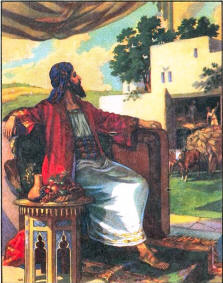
"And He spake a parable unto them, saying, The ground of a certain rich man
brought forth plentifully; and he thought within himself, saying, What shall I do, because
I have no room where to bestow my fruits? And he said, This will I do: I will pull down my
barns, and build greater; and there will I bestow all my fruits and my goods. And I will
say to my soul, Soul, thou hast much goods laid up for many years; take thine ease, eat, drink, be merry. But God said unto him,
Thou fool, this night thy soul shall be required of thee: then whose shall these things
be, which thou hast provided? So is he that layeth up treasure for himself,and is not rich
toward God."
By the parable of the foolish rich man, Christ showed the folly of those who make the
world their all. This man had received everything from God. The sun had been permitted to
shine upon his land; for its rays fall on the just and on the unjust. The showers of
heaven descend on the evil and on the good. The Lord had caused vegetation to flourish,
and the fields to bring forth abundantly. The rich man was in perplexity as to what he
should do with his produce. His barns were full to overflowing, and he had no place to put
the surplus of his harvest. He did not think of God, from whom all his mercies had come.
He did not realize that God had made him a steward of His goods that he might help the
needy. He had a blessed opportunity of being God's almoner, but he thought only of
ministering to his own comfort.
The situation of the poor, the orphan, the widow, the suffering, the afflicted, was
brought to this rich man's attention; there were many places in which to bestow his goods.
He could easily have relieved himself of a portion of his abundance, and many homes would
have been freed from want, many who were hungry would have been fed, many naked clothed,
many hearts made glad, many prayers for bread and clothing answered, and a melody of
praise would have ascended to heaven. The Lord had heard the prayers of the needy, and of
His goodness He had prepared for the poor. (Ps. 68:10.) Abundant provision for the wants
of many had been made in the blessings bestowed upon the rich man. But he closed his heart
to the cry of the needy, and said to his servants, "This will I do: I will pull
down my barns, and build greater; and there will I bestow all my fruits and my goods.
And I will say to my soul, Soul, thou hast much goods laid up for many years; take thine
ease, eat, drink, and be merry."
This man's aims were no higher than those of the beasts that perish. He lived as if
there were no God, no heaven, no future life; as if everything he possessed were his own, and he owed nothing to God
or man. The psalmist described this rich man when he wrote, "The fool hath said in
his heart, There is no God." Ps. 14:1.
This man has lived and planned for self. He sees that the future is abundantly provided
for; there is nothing for him now but to treasure and enjoy the fruits of his labors. He
regards himself as favored above other men, and takes credit to himself for his wise
management. He is honored by his fellow townsmen as a man of good judgment and a
prosperous citizen. For "men will praise thee, when thou doest well to thyself."
Ps. 49:18.
But "the wisdom of this world is foolishness with God." 1 Cor. 3:19. While
the rich man is looking forward to years of enjoyment, the Lord is making far different
plans. The message comes to this unfaithful steward, "Thou fool, this night thy soul
shall be required of thee." Here is a demand that money cannot supply. The wealth he
has treasured can purchase no reprieve. In one moment that which he has toiled through his
whole life to secure becomes worthless to him. "Then whose shall those things be
which thou hast provided?" His broad fields and well-filled granaries pass from under
his control. "He heapeth up riches, and knoweth not who shall gather them." Ps.
39:6.
The only thing that would be of value to him now he has not secured. In living for self
he has rejected that divine love which would have flowed out in mercy to his fellow men.
Thus he has rejected life. For God is love, and love is life. This man has chosen the
earthly rather than the spiritual, and with the earthly he must pass away. "Man that
is in honour, and understandeth not, is like the beasts that perish." Ps. 49:20.
"So is he that layeth up treasure for himself, and is not
rich toward God." The picture is true for all time. You may plan for merely
selfish good, you may gather together treasure, you may build mansions great and high, as
did the builders of ancient Babylon; but you cannot build wall so high or gate so strong
as to shut out the messengers of doom. Belshazzar the king "feasted in his
palace," and "praised the gods of gold, and of silver, of brass, of iron, of
wood, and of stone." But the hand of One invisible wrote upon his walls the words of
doom, and the tread of hostile armies was heard at his palace gates. "In that night
was Belshazzar the king of the Chaldeans slain," and an alien monarch sat upon the
throne. (Dan. 5:30)
To live for self is to perish. Covetousness, the desire of benefit for self's sake,
cuts the soul off from life. It is the spirit of Satan to get, to draw to self. It is the
spirit of Christ to give, to sacrifice self for the good of others. "And this is the
record, that God hath given to us eternal life, and this life is in His Son. He that hath
the Son hath life; and he that hath not the Son of God hath not life." 1 John 5:11,
12.
Wherefore He says, "Take heed, and beware of covetousness; for a man's life
consisteth not in the abundance of the things which he possesseth."
|
