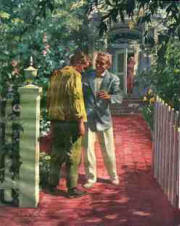
"Lost and is Found"
[This chapter is based on Luke 15:11-32.]
The parables of the lost sheep, the lost coin, and the prodigal son, bring out in
distinct lines God's pitying love for those who are straying from Him. Although they have
turned away from God, He does not leave them in their misery. He is full of kindness and
tender pity toward all who are exposed to the temptations of the artful foe.
In the parable of the prodigal son is presented the Lord's dealing with those who have
once known the Father's love, but who have allowed the tempter to lead them captive at his
will.
"A certain man had two sons; and the younger of them said to his father, Father,
give me the portion of goods that falleth to me. And he divided unto them his living. And
not many days after the younger son gathered all together, and took his journey into a far
country."
This younger son had become weary of the restraint of his father's house. He thought
that his liberty was restricted. His father's love and care for him were misinterpreted,
and he determined to follow the dictates of his own inclination.
The youth acknowledges no obligation to his father, and expresses no gratitude; yet he
claims the privilege of a child in sharing his father's goods. The inheritance that would
fall to him at his father's death he desires to receive now. He is bent on present
enjoyment, and cares not for the future.
Having obtained his patrimony, he goes into "a far country," away from his
father's home. With money in plenty, and liberty to do as he likes, he flatters himself
that the desire of his heart is reached. There is no one to say, Do not do this, for it
will be an injury to yourself; or, Do this, because it is right. Evil companions help him
to plunge ever deeper into sin, and he wastes his "substance with riotous
living."
The Bible tells of men who "professing themselves to be wise" "became
fools" (Rom. 1:22); and this is the history of the young man of the parable. The
wealth which he has selfishly claimed from his father he squanders upon harlots. The
treasure of his young manhood is wasted. The precious years of life, the strength of intellect, the bright visions of youth, the
spiritual aspirations--all are consumed in the fires of lust.
A great famine arises, he begins to be in want, and he joins himself to a citizen of
the country, who sends him into the field to feed swine. To a Jew this was the most menial
and degrading of employments. The youth who has boasted of his liberty, now finds himself
a slave. He is in the worst of bondage--"holden with the cords of his sins."
(Prov. 5:22.) The glitter and tinsel that enticed him have disappeared, and he feels the
burden of his chain. Sitting upon the ground in that desolate and famine-stricken land,
with no companions but the swine, he is fain to fill himself with the husks on which the
beasts are fed. Of the gay companions who flocked about him in his prosperous days and ate
and drank at his expense, there is not one left to befriend him. Where now is his riotous
joy? Stilling his conscience, benumbing his sensibilities, he thought himself happy; but
now, with money spent, with hunger unsatisfied, with pride humbled, with his moral nature
dwarfed, with his will weak and untrustworthy, with his finer feelings seemingly dead, he
is the most wretched of mortals.
What a picture here of the sinner's state! Although surrounded with the blessings of
His love, there is nothing that the sinner, bent on self-indulgence and sinful pleasure,
desires so much as separation from God. Like the ungrateful son, he claims the good things
of God as his by right. He takes them as a matter of course, and makes no return of
gratitude, renders no service of love. As Cain went out from the presence of the Lord to
seek his home; as the prodigal wandered into the "far country," so do sinners
seek happiness in forgetfulness of God. (Rom. 1:28.)
Whatever the appearance may be, every life centered in self squandered. Whoever
attempts to live apart from God is wasting his substance. He is squandering the precious years, squandering the
powers of mind and heart and soul, and working to make himself bankrupt for eternity. The
man who separates from God that he may serve himself, is the slave of mammon. The mind
that God created for the companionship of angels has become degraded to the service of
that which is earthly and bestial. This is the end to which self-serving tends.
If you have chosen such a life, you know that you are spending money for that which is
not bread, and labor for that which satisfieth not. There come to you hours when you
realize your degradation. Alone in the far country you feel your misery, and in despair
you cry, "O wretched man that I am! who shall deliver me from the body of this
death?" Rom. 7:24. It is the statement of a universal truth which is contained in the
prophet's words, "Cursed be the man that trusteth in man, and maketh flesh his arm,
and whose heart departeth from the Lord. For he shall be like the heath in the desert, and
shall not see when good cometh; but shall inhabit the parched places in the wilderness, in
a salt land and not inhabited." Jer. 17:5, 6. God "maketh His sun to rise on the evil and on the good, and sendeth rain on the just and on the
unjust" (Matt. 5:45); but men have the power to shut themselves away from sunshine
and shower. So while the Sun of Righteousness shines, and the showers of grace fall freely
for all, we may by separating ourselves from God still "inhabit the parched places in
the wilderness."
The love of God still yearns over the one who has chosen to separate from Him, and He
sets in operation influences to bring him back to the Father's house. The prodigal son in
his wretchedness "came to himself." The deceptive power that Satan had exercised
over him was broken. He saw that his suffering was the result of his own folly, and he
said, "How many hired servants of my father's have bread enough and to spare, and I
perish with hunger! I will arise and go to may father." Miserable as he was, the
prodigal found hope in the conviction of his father's love. It was that love which was
drawing him toward home. So it is the assurance of God's love that constrains the sinner
to return to God. "The goodness of God leadeth thee to repentance." Rom. 2:4. A
golden chain, the mercy and compassion of divine love, is passed around every imperiled
soul. The Lord declares, "I have loved thee with an everlasting love; therefore with
loving-kindness have I drawn thee." Jer.31:3.
The son determines to confess his guilt. He will go to his father, saying, "I have
sinned against heaven, and before thee, and am no more worthy to be called thy son."
But he adds, showing how stinted is his conception of his father's love, "Make me as
one of thy hired servants."
The young man turns from the swine herds and the husks, and sets his face toward home.
Trembling with weakness and faint from hunger, he presses eagerly on his way. He has no
covering to conceal his rags; but his misery has conquered pride ,and he hurries on to beg a servant's place where he was
once a child.
Little did the gay, thoughtless youth, as he went out from his father's gate, dream of
the ache and longing left in that father's heart. When he danced and feasted with his wild
companions, little did he think of the shadow that had fallen on his home. And now as with
weary and painful steps he pursues the homeward way, he knows not that one is watching for
his return. But while he is yet "a great way off" the father discerns his form.
Love is of quick sight. Not even the degradation of the years of sin can conceal the son
from the father's eyes. He "had compassion, and ran, and fell on his neck" in a
long, clinging, tender embrace.
The father will permit no contemptuous eye to mock at his son's misery and tatters. He
takes from his own shoulders the broad, rich mantle, and wraps it around the
son's wasted form, and the youth sobs out his repentance, saying, "Father, I have
sinned against heaven, and in thy sight, and am no more worthy to be called thy son."
The father holds him close to his side, and brings him home. No opportunity is given him
to ask a servant's place. He is a son, who shall be honored with the best the house
affords, and whom the waiting men and women shall respect and serve.
The father said to his servants, "Bring forth the best robe, and put it on him;
and put a ring on his hand, and shoes on his feet; and bring hither the fatted calf, and
kill it; and let us eat and be merry; for this my son was dead, and is alive again; he was
lost, and is found. And they began to be merry."
In his restless youth the prodigal looked upon his father as stern and severe. How
different his conception of him now! So those who are deceived by Satan look upon God as
hard and exacting. They regard Him as watching to denounce and condemn, as unwilling to
receive the sinner so long as there is a legal excuse for not helping him. His law they
regard as a restriction upon men's happiness, a burdensome yoke from which they are glad
to escape. But he whose eyes have been opened by the love of Christ will behold God as
full of compassion. He does not appear as a tyrannical, relentless being, but as a father
longing to embrace his repenting son. The sinner will exclaim with the Psalmist,
"Like as a father pitieth his children, so the Lord pitieth them that fear Him."
Ps. 103:13.
In the parable there is no taunting, no casting up to the prodigal of his evil course.
The son feels that the past is forgiven and forgotten, blotted out forever. And so God
says to the sinner, "I have blotted out, as a thick cloud, thy transgressions, and,
as a cloud, thy sins," Isa. 44:22. "I will forgive their iniquity, and I will
remember their sin no more." Jer. 31:34. "Let the wicked forsake his way, and the
unrighteous man his thoughts; and let him return unto the Lord, and He will have mercy
upon him; and to our God, for He will abundantly pardon." Isa. 55:7. "In those
days, and in that time, saith the Lord, the iniquity of Israel shall be sought for, and
there shall be none; and the sins of Judah, and they shall not be found." Jer. 50:20.
What assurance here, of God's willingness to receive the repenting sinner! Have you,
reader, chosen your own way? Have you wandered far from God? Have you sought to feast upon
the fruits of transgression, only to find them turn to ashes upon your lips? And now, your
substance spent, your life-plans thwarted, and your hopes dead, do you sit alone and
desolate? Now that voice which has long been speaking to your heart but to which you would
not listen comes to you distinct and clear, "Arise ye, and depart; for this is not
your rest; because it is polluted, it shall destroy you, even with a sore
destruction." Micah 2:10. Return to your Father's house. He invites you, saying,
"Return unto Me; for I have redeemed thee." Isa. 44:22.
Do not listen to the enemy's suggestion to stay away from Christ until you have made
yourself better; until you are good enough to come to God. If you wait until then,
you will never come. When Satan points to your filthy garments, repeat the promise of
Jesus, "Him that cometh to Me I will in no wise cast out." John 6:37. Tell the
enemy that the blood of Jesus Christ cleanses from all sin. Make the prayer of David your
own, "Purge me with hyssop, and I shall be clean; wash me, and I shall be whiter than
snow." Ps. 51:7.
Arise and go to your Father. He will meet you a great way off. If you take even one
step toward Him in repentance, He will hasten to enfold you in His arms of infinite love.
His ear is open to the cry of the contrite soul. The very first reaching out of the heart
after God is known to Him. Never a prayer is offered, however faltering, never a tear is
shed, however secret, never a sincere desire after God is cherished, however feeble, but
the Spirit of God goes forth to meet it. Even before the prayer is uttered or the yearning
of the heart made known, grace from Christ goes forth to meet the grace that is working
upon the human soul.
Your heavenly Father will take from you the garments defiled by sin. In the beautiful
parabolic prophecy of Zechariah, the high priest Joshua, standing clothed in filthy
garments before the angel of the Lord, represents the sinner. And the word is spoken by
the Lord, "Take away the filthy garments from him. And unto him He said, Behold, I
have caused thine iniquity to pass from thee, and I will clothe thee with change of
raiment. . . . So they set a fair miter upon his head, and clothed him with
garments." Zech. 3:4, 5. Even so God will clothe you with "the garments of
salvation," and cover you with "the robe of righteousness." Isa. 61:10.
"Though ye have lien among the pots, yet shall ye be as the wings of a dove covered
with silver, and her feathers with yellow gold." Ps. 68:13.
He will bring you into His banqueting house, and His
banner over you shall be love. (Cant. 2:4) "If thou wilt walk in My ways," He
declares, "I will give thee places to walk among these that stand by"--even
among the holy angels that surround His throne. (Zech. 3:7.)
"As the bridegroom rejoiceth over the bride, so shall thy God rejoice over
thee." Isa. 62:5. "He will save, He will rejoice over thee with joy; He will
rest in His love; He will joy over thee with singing." Zeph. 3:17. And heaven and
earth shall unite in the Father's song of rejoicing: "For this My son was dead, and
is alive again; he was lost, and is found."
Thus far in the Saviour's parable there is no discordant note to jar the harmony of the
scene of joy; but now Christ introduces another element. When the prodigal came home, the
elder son "was in the field; and as he came and drew nigh to the house, he heard
music and dancing. And he called one of the servants, and asked what these things meant.
And he said unto him, Thy brother is come; and thy father hath killed the fatted calf,
because he hath received him safe and sound. And he was angry, and would not go in."
This elder brother has not been sharing in his father's anxiety and watching for the one
that was lost. He shares not, therefore, in the father's joy at the wanderer's return. The
sounds of rejoicing kindle no gladness in his heart. He inquires of a servant the reason
of the festivity, and the answer excites his jealousy. He will not go in to welcome his
lost brother. The favor shown the prodigal he regards as an insult to himself.
When the father comes out to remonstrate with him, the pride and malignity of his
nature are revealed. He dwells upon his own life in his father's house as a round of
unrequited service, and then places in mean contrast the favor shown to the son just
returned. He makes it plain that his own service has been that of a servant rather
than a son. When he should have found an abiding joy in his father's presence, his mind
has rested upon the profit to accrue from his circumspect life. His words show that it is
for this he has foregone the pleasures of sin. Now if this brother is to share in the
father's gifts, the elder son counts that he himself has been wronged. He grudges his
brother the favor shown him. He plainly shows that had he been in the father's place, he
would not have received the prodigal. He does not even acknowledge him as a brother, but
coldly speaks of him as "thy son."
Yet the father deals tenderly with him. "Son," he says, "thou art ever
with me, and all that I have is thine." Through all these years of your brother's
outcast life, have you not had the privilege of companionship with me?
Everything that could minister to the happiness of his
children was freely theirs. The son need have no question of gift or reward. "All
that I have is thine." You have only to believe my love, and take the gift that is
freely bestowed.
One son had for a time cut himself off from the household, not discerning the father's
love. But now he has returned, and the tide of joy sweeps away every disturbing thought.
"This thy brother was dead, and is alive again; and was lost, and is found."
Was the elder brother brought to see his own mean, ungrateful spirit? Did he come to
see that though his brother had done wickedly, he was his brother still? Did the elder
brother repent of his jealousy and hardheartedness? Concerning this, Christ was silent.
For the parable was still enacting, and it rested with His hearers to determine what the
outcome should be.
By the elder son were represented the unrepenting Jews of Christ's day, and also the
Pharisees in every age, who look with contempt upon those whom they regard as publicans
and sinners. Because they themselves have not gone to great excesses in vice, they are
filled with self-righteousness. Christ met these cavilers on their own ground. Like the
elder son in the parable, they had enjoyed special privileges from God. They claimed to be
sons in God's house, but they had the spirit of the hireling. They were working, not from
love, but from hope of reward. In their eyes, God was an exacting taskmaster. They saw
Christ inviting publicans and sinners to receive freely the gift of His grace--the gift
which the rabbis hoped to secure only by toil and penance--and they were offended. The
prodigal's return, which filled the Father's heart with joy, only stirred them to
jealousy.
In the parable the father's remonstrance with the elder son was Heaven's tender appeal
to the Pharisees. "All that I have is thine"--not as wages, but as a gift. Like the prodigal, you can receive
it only as the unmerited bestowal of the Father's love.
Self-righteousness not only leads men to misrepresent God, but makes them coldhearted
and critical toward their brethren. The elder son, in his selfishness and jealousy, stood
ready to watch his brother, to criticize every action, and to accuse him for the least
deficiency. He would detect every mistake, and make the most of every wrong act. Thus he
would seek to justify his own unforgiving spirit. Many today are doing the same thing.
While the soul is making its very first struggles against a flood of temptations, they
stand by, stubborn, self-willed, complaining, accusing. They may claim to be children of
God, but they are acting out the spirit of Satan. By their attitude toward their brethren,
these accusers place themselves where God cannot give them the light of His countenance.
Many are constantly questioning, "Wherewith shall I come before the Lord, and bow
myself before the high God? Shall I come before Him with burnt-offerings, with calves of a
year old? Will the Lord be pleased with thousands of rams, or with ten thousands of rivers
of oil?" But "He hath showed thee, O man, what is good; and what doth the Lord
require of thee, but to do justly, and to love mercy, and to walk humbly with thy
God?" Micah 6:6-8.
This is the service that God has chosen--"to loose the bands of wickedness, to
undo the heavy burdens, and to let the oppressed go free, and that ye break every yoke, .
. . and that thou hide not thyself from thine own flesh." Isa. 58:6, 7. When you see
yourselves as sinners saved only by the love of your heavenly Father, you will have tender
pity for others who are suffering in sin. You will no longer meet misery and repentance
with jealousy and censure. When the ice of selfishness is melted from your hearts, you will be in sympathy with
God, and will share His joy in the saving of the lost.
It is true that you claim to be a child of God; but if this claim be true, it is
"thy brother" that was "dead, and is alive again; and was lost, and is
found." He is bound to you by the closest ties; for God recognizes him as a son. Deny
your relationship to him, and you show that you are but a hireling in the household, not a
child in the family of God.
Though you will not join in the greeting to the lost, the joy will go on, the restored
one will have his place by the Father's side and in the Father's work. He that is forgiven
much, the same loves much. But you will be in the darkness without. For "he that
loveth not knoweth not God; for God is love." 1 John 4:8.
|
