The Measure of Forgiveness
[This chapter is based on Matt. 18:21-35.]
Peter had come to Christ with the question, "How oft shall my brother sin against
me, and I forgive him? till seven times?" The rabbis limited the exercise of
forgiveness to three offenses. Peter, carrying out, as he supposed, the teaching of
Christ, thought to extend it to seven, the number signifying perfection. But Christ taught
that we are never to become weary of forgiving. Not "Until seven times," He
said, "but, Until seventy times seven."
Then He showed the true ground upon which forgiveness is to be granted and the danger
of cherishing an unforgiving spirit. In a parable He told of a king's dealing with the
officers who administered the affairs of his government. Some of these officers were in
receipt of vast sums of money belonging to the state. As the king investigated their
administration of this trust, there was brought before him one man whose account showed a
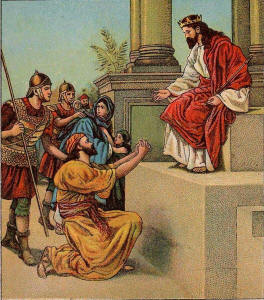
debt to his lord for the immense sum of ten thousand talents. He had nothing to pay, and according to the custom, the king ordered him to be sold, with all
that he had, that payment might be made. But the terrified man fell at his feet and
besought him, saying, "Have patience with me, and I will pay thee all. Then the lord
of that servant was moved with compassion, and loosed him, and forgave him the debt.
"But the same servant went out, and found one of his fellowservants, which owed
him an hundred pence; and he laid hands on him, and took him by the throat, saying, Pay me
that thou owest. And his fellowservant fell down at his feet, and besought him, saying,
Have patience with me, and I will pay thee all. And he would not; but went and cast him
into prison, till he should pay the debt. So when his fellowservants saw what was done,
they were very sorry, and came and told unto their lord all that was done. Then his lord,
after that he had called him, said unto him, O thou wicked servant, I forgave thee all
that debt, because thou desiredst me: shouldest not thou also have had compassion on thy
fellowservant, even as I had pity on thee? And his lord was wroth, and delivered him to
the tormentors, till he should pay all that was due unto him."
This parable presents details which are needed for the filling out of the picture but
which have no counterpart in its spiritual significance. The attention should not be
diverted to them. Certain great truths are illustrated, and to these our thought should be
given.
The pardon granted by this king represents a divine forgiveness of all sin. Christ is
represented by the king, who, moved with compassion, forgave the debt of his servant. Man
was under the condemnation of the broken law. He could not save himself, and for this
reason Christ came to this world, clothed His divinity with humanity, and gave His life,
the just for the unjust. He gave Himself for our sins, and to every soul He freely offers the blood-bought pardon. "With
the Lord there is mercy, and with Him is plenteous redemption." Ps. 130:7.
Here is the ground upon which we should exercise compassion toward our fellow sinners.
"If God so loved us, we ought also to love one another." John 4:11. "Freely
ye have received," Christ says, "freely give." Matt. 10:8.
In the parable, when the debtor pleaded for delay, with the promise, "Have
patience with me, and I will pay thee all," the sentence was revoked. The whole debt
was canceled. And he was soon given an opportunity to follow the example of the master who
had forgiven him. Going out, he met a fellow servant who owed him a small sum. He had been
forgiven ten thousand talents; the debtor owed him a hundred pence. But he who had been so
mercifully treated, dealt with his fellow laborer in an altogether different manner. His
debtor made an appeal similar to that which he himself had made to the king, but without a
similar result. He who had so recently been forgiven was not tenderhearted and pitiful.
The mercy shown him he did not exercise in dealing with his fellowservant. He heeded not
the request to be patient. The small sum owed to him was all that the ungrateful servant
would keep in mind. He demanded all that he thought his due, and carried into effect a
sentence similar to that which had been so graciously revoked for him.
How many are today manifesting the same spirit. When the debtor pleaded with his lord
for mercy, he had no true sense of the greatness of his debt. He did not realize his
helplessness. He hoped to deliver himself. "Have patience with me," he said,
"and I will pay thee all." So there are many who hope by their own works to
merit God's favor. They do not realize their helplessness. They do not accept the grace of God as a free gift, but are trying to build themselves up in
self-righteousness. Their own hearts are not broken and humbled on account of sin, and
they are exacting and unforgiving toward others. Their own sins against God, compared with their brother's sins against them, are as ten
thousand talents to one hundred pence --nearly one million to one; yet they dare to be
unforgiving.
In the parable the lord summoned the unmerciful debtor, and "said unto him, O thou
wicked servant, I forgave thee all that debt, because thou desiredst me; shouldest not
thou also have had compassion on thy fellowservant, even as I had pity on thee? And his
lord was wroth, and delivered him to the tormentors, till he should pay all that was due
unto him." "So likewise," said Jesus, "shall My Heavenly Father do
also unto you, if ye from your hearts forgive not every one his brother their
trespasses." He who refuses to forgive is thereby casting away his own hope of
pardon.
But the teaching of this parable should not be misapplied. God's forgiveness toward us
lessens in no wise our duty to obey Him. So the spirit of forgiveness toward our fellow
men does not lessen the claim of just obligation. In the prayer which Christ taught His
disciples He said, "Forgive us our debts, as we forgive our debtors." Matt.
6:12. By this He did not mean that in order to be forgiven our sins we must not require
our just dues from our debtors. If they cannot pay, even though this may be the result of
unwise management, they are not to be cast into prison, oppressed, or even treated
harshly; but the parable does not teach us to encourage indolence. The word of God
declares that if a man will not work, neither shall he eat. (2 Thess. 3:10.) The Lord does
not require the hard-working man to support others in idleness. With many there is a waste
of time, a lack of effort, which brings to poverty and want. If these faults are not
corrected by those who indulge them, all that might be done in their behalf would be like
putting treasure into a bag with holes. Yet there is an unavoidable poverty, and we are to
manifest tenderness and compassion toward those who are unfortunate. We should treat others just as we ourselves, in like circumstances, would wish to be
treated.
The Holy Spirit through the apostle Paul charges us: "If there be therefore any
consolation in Christ, if any comfort of love, if any fellowship of the Spirit, if any
bowels and mercies, fulfil ye my joy, that ye be like-minded, having the same love, being
of one accord, of one mind. Let nothing be done through strife or vainglory; but in
lowliness of mind let each esteem other better than themselves. Look not every man on his
own things, but every man also on the things of others. Let this mind be in you, which was
also in Christ Jesus." Phil. 2:1-5.
But sin is not to be lightly regarded. The Lord has commanded us not to suffer wrong
upon our brother. He says, "If thy brother trespass against thee, rebuke him."
Luke 17:3. Sin is to be called by its right name, and is to be plainly laid out before the
wrongdoer.
In his charge to Timothy, Paul, writing by the Holy Spirit, says, "Be instant in
season, out of season; reprove, rebuke, exhort with all longsuffering and doctrine."
2 Tim. 4:2. And to Titus he writes, "There are many unruly and vain talkers and
deceivers. . . . Wherefore rebuke them sharply, that they may be sound in the faith."
Titus 1:10-13.
"If thy brother shall trespass against thee," Christ said, "go and tell
him his fault between thee and him alone: if he shall hear thee, thou hast gained thy
brother. But if he will not hear thee, then take with thee one or two more, that in the
mouth of two or three witnesses every word may be established. And if he shall neglect to
hear them, tell it unto the church: but if he neglect to hear the church, let him be unto
thee as an heathen man and a publican." Matt. 18:15-17.
Our Lord teaches that matters of difficulty between Christians are to be settled within
the church. They should not be opened before those who do not fear God. If a Christian is wronged by his
brother, let him not appeal to unbelievers in a court of justice. Let him follow out the
instruction Christ has given. Instead of trying to avenge himself, let him seek to save
his brother. God will guard the interests of those who love and fear Him, and with
confidence we may commit our case to Him who judges righteously.
Too often when wrongs are committed again and again, and the wrongdoer confesses his
fault, the injured one becomes weary, and thinks he has forgiven quite enough. But the
Saviour has plainly told us how to deal with the erring: "If thy brother trespass
against thee, rebuke him; and if he repent, forgive him." Luke 17:3. Do not hold him
off as unworthy of your confidence. Consider "thyself, lest thou also be
tempted." Gal. 6:1.
If your brethren err, you are to forgive them. When they come to you with confession,
you should not say, I do not think they are humble enough. I do not think they feel their confession. What
right have you to judge them, as if you could read the heart? The word of God says,
"If he repent, forgive him. And if he trespasses against thee seven times in a day,
and seven times in a day turn again to thee, saying, I repent; thou shalt forgive
him." Luke 17:3, 4. And not only seven times, but seventy times seven--just as often
as God forgives you.
We ourselves owe everything to God's free grace. Grace in the covenant ordained our
adoption. Grace in the Saviour effected our redemption, our regeneration, and our
exaltation to heirship with Christ. Let this grace be revealed to others.
Give the erring one no occasion for discouragement. Suffer not a Pharisaical hardness
to come in and hurt your brother. Let no bitter sneer rise in mind or heart. Let no tinge
of scorn be manifest in the voice. If you speak a word of your own, if you take an
attitude of indifference, or show suspicion or distrust, it may prove the ruin of a soul.
He needs a brother with the Elder Brother's heart of sympathy to touch his heart of
humanity. Let him feel the strong clasp of a sympathizing hand, and hear the whisper, Let
us pray. God will give a rich experience to you both. Prayer unites us with one another
and with God. Prayer brings Jesus to our side, and gives to the fainting, perplexed soul
new strength to overcome the world, the flesh, and the devil. Prayer turns aside the
attacks of Satan.
When one turns away from human imperfections to behold Jesus, a divine transformation
takes place in the character. The Spirit of Christ working upon the heart conforms it to
His image. Then let it be your effort to lift up Jesus. Let the mind's eye be directed to
"the Lamb of God, which taketh away the sin of the world." John 1:29. And as you
engage in this work, remember that "he which converteth the sinner from the error of his way, shall save a soul from death,
and shall hide a multitude of sins." James 5:20.
"But if ye forgive not men their trespasses, neither will your Father forgive your
trespasses." Matt. 6:15. Nothing can justify an unforgiving spirit. He who is
unmerciful toward others shows that he himself is not a partaker of God's pardoning grace.
In God's forgiveness the heart of the erring one is drawn close to the great heart of
Infinite Love. The tide of divine compassion flows into the sinner's soul, and from him to
the souls of others. The tenderness and mercy that Christ has revealed in His own precious
life will be seen in those who become sharers of His grace. But "if any man have not
the Spirit of Christ, he is none of His." Rom. 8:9. He is alienated from God, fitted
only for eternal separation from Him.
It is true that he may once have received forgiveness; but his unmerciful spirit shows
that he now rejects God's pardoning love. He has separated himself from God, and is in the
same condition as before he was forgiven. He has denied his repentance, and his sins are
upon him as if he had not repented.
But the great lesson of the parable lies in the contrast between God's compassion and
man's hardheartedness; in the fact that God's forgiving mercy is to be the measure of our
own. "Shouldest not thou also have had compassion on thy fellowservant, even as I had
pity on thee?"
We are not forgiven because we forgive, but as we forgive. The ground of
all forgiveness is found in the unmerited love of God, but by our attitude toward others
we show whether we have made that love our own. Wherefore Christ says, "With what
judgment ye judge, ye shall be judged; and with what measure ye mete, it shall be measured
to you again." Matt. 7:2.
|
